economy
Why does the letter e flip under a microscope
Written by Ava Bailey — 0 Views
Why is the image inverted in a microscope?
As we mentioned above, an image is inverted because it goes through two lens systems, and because of the reflection of light rays. The two lenses it goes through are the ocular lens and the objective lens. An ocular lens is the one closest to your eye when looking through a microscope or telescope.How does the letter E show under the microscope?
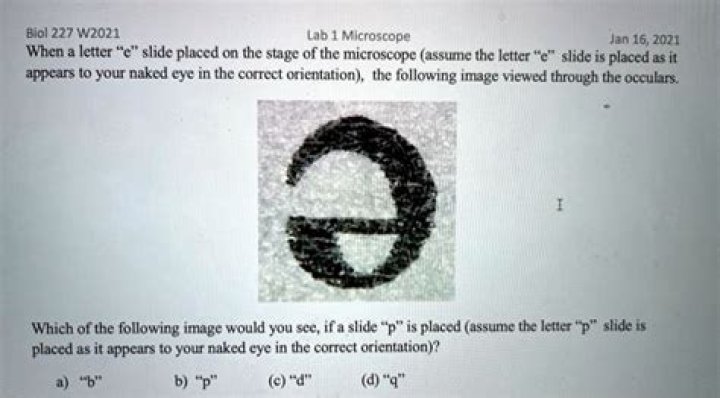
Notice that it appears upside down when viewed under the microscope. This is a picture of the letter “e” shown at 100X. Notice, that as you increase the power of the lens, your field of view gets smaller.What happened to the letter E when you move the slide to the left?
The “e” is flipped and backwards. 3. While looking through the microscope, move the slide to the left, notice which way the letter “e” moved. Now move the slide to the right.What is the difference between inverted and upright microscope?
Upright microscopes have objectives placed above the stage where you put your sample; inverted microscopes have objectives below the stage where you put your sample.What does inverted image mean?
upside down Inverted image means the image is upside down compared to the object. The real images formed by the concave mirrors are inverted. The rays from the top edge of the object are reflected downwards below the principal axis by the concave mirror. … This forms an inverted image.What happened to the orientation of the letter E when viewing it under the microscope?
– The letter “e” – The viewing of this familiar letter will provide practice in orienting the slide and using the objective lenses. The letter appears upside down and backwards because of two sets of mirrors in the microscope.What is the effect of shifting from LPO to HPO?
Changing from low power to high power increases the magnification of a specimen. The amount an image is magnified is equal to the magnification of the ocular lens, or eyepiece, multiplied by the magnification of the objective lens.When you move the stage forward which direction did the E move?
How well do you know your Microscope?| A | B |
|---|---|
| field of view | illuminated circle |
| pointer | skinny object in eyepiece |
| depths | adjusting the fine focus allows you to see things at different … |
| 10x X 40 = 400X | total magnification |
Why do you need to focus specimens under the LPO first before focusing under the HBO?
Explanation: Using the low power objective (LPO) gives us an overview of a specimen. If there is anything specific you want to observe, it would be easier to identify it first using the LPO and then zooming in on it using the high power objective (HPO).What is the position of the letter E as seen under the low power objective LPO?
The glass slide was placed on the stage making sure that the letter “e” was at the center of the hole on the stage and under the low power objective. It was held firmly with the stage clips.What does it mean that the image is inverted when you look through the ocular lenses?
What does it mean that the image is inverted when you look through the ocular lenses? The ocular lens or eyepiece lens acts as a magnifying glass for the image, the ocular lens makes the light rays spread more so that they appear to come from a larger inverted image beyond the objective lands.Why must you turn the nosepiece to the LPO before putting the microscope away?
Leaving the low-power objective in place thus makes it more convenient, easier & quicker for the next user of the microscope to immediately place a specimen-containing slide on the stage and observe it under the low-power objective, instead of having to swing the nosepiece to bring the low-power objective into position …What is LPO and HBO in objectives?
MAGNIFYING PARTS • Objectives – Metal cylinders attached below the nosepiece and contains especially ground and polished lenses • LPO / Low Power Objective – Gives the lowest magnification, usually 10x • HPO / High Power Objective – Gives higher magnification usually 40x or 43x • OIO / Oil Immersion Objective – Gives …Why do you need to focus specimen?
The depth of focus is greatest on the lowest power objective. Each time you switch to a higher power, the depth of focus is reduced. Therefore a smaller part of the specimen is in focus at higher power. Again, this makes it easier to find an object on low power, and then switch to higher power after it is in focus.Why is it important to allow the microscope to cool before putting it away?
After using your microscope, turn off the illuminator and wait for it to cool down before putting it away. Allowing the bulb to cool will extend its life and avoid the unnecessary cost of expensive replacements. Similarly, if used constantly on full power, the bulb will overheat and blow.Why must the slide be kept in place?
Specimens are often held into place using the smaller glass cover slips. … It protects the microscope’s objective lens from contacting the specimen and vice versa; in oil immersion microscopy or water immersion microscopy the cover slip prevents contact between the immersion liquid and the specimen.Should you turn off the microscope light before putting it away?
Always place the 4X objective over the stage and be sure the stage is at its lowest position before putting the microscope away. 9. Always turn off the light before putting the microscope away. … Always wrap the cord correctly before putting the microscope away.When carrying the microscope Why should on hand hold the bottom of the base?
Hold the microscope with one hand around the arm of the device, and the other hand under the base. This is the most secure way to hold and walk with the microscope. Avoid touching the lenses of the microscope. The oil and dirt on your fingers can scratch the glass.Why are microscope lenses not touched?
Never touch the lenses with your fingers. Your body produces an oil that smudges the glass. This oil can even etch the glass if left on too long. Use only LENS PAPER to clean the glass.Why is it important to have both eyes opened when using the microscope?
If your eyes are too close set or far apart for the intraocular distance to be adjusted properly, you will have to use your microscope as a monocular instrument (i.e. look through one eyepiece with one eye). If you do this, it is important to keep both eyes open in order to avoid eyestrain.What does the base do on a microscope?
Base: The bottom of the microscope, used for support Illuminator: A steady light source (110 volts) used in place of a mirror.When moving your microscope always carry it with both hands grasp the arm with one hand and place the other hand under the base for support?
When moving your microscope, always carry it with both hands (Figure 1, at left). Grasp the arm with one hand and place the other hand under the base for support. Turn the revolving nosepiece so that the lowest power objective lens is “clicked” into position (This is also the shortest objective lens).How does the position of a specimen appear under the microscope?
A specimen that is right-side up and facing right on the microscope slide will appear upside-down and facing left when viewed through a microscope, and vice versa. Similarly, if the slide is moved left while looking through the microscope, it will appear to move right, and if moved down, it will seem to move up.What is the function of the mirror in a microscope?
If your microscope has a mirror, it is used to reflect light from an external light source up through the bottom of the stage.Related Archive

Noorul Islam University Admit Card 2022 - 2023 |Online Download Hall Ticket

87 Best Bruce Lee Quotes of All Time to Trigger Personal Growth

Todd Hoffman Net Worth and Salary per Episode. Meet his Wife, Children, Family, Wiki