technology trends
What is a primary bonding
Written by Avery Gonzales — 0 Views
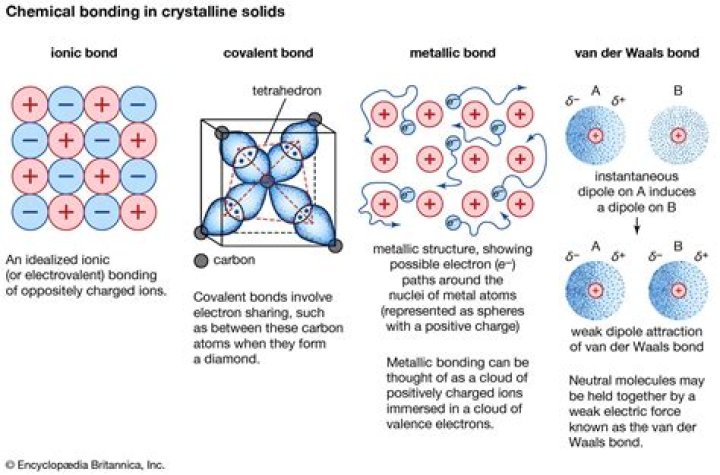
What are the primary types of bonds?
There are three primary types of bonding: ionic, covalent, and metallic.- Ionic bonding.
- Covalent bonding.
- Metallic bonding.
What is difference between primary bonding and secondary bonding?
Primary bonds are formed when the bonding process involves a transfer or sharing of electrons. Secondary bonds are formed from the subtle attraction forces between positive and negative charges. There is no transfer or sharing of electrons involved in a secondary bond.What is a secondary bonding?
Secondary bonds are not bonds with a valence electron being shared or donated. They are usually formed when an uneven charge distribution occurs, creating what is known as a dipole (the total charge is zero, but there is slightly more positive or negative charge on one end of the atom than on the other).What are the 4 types of bonding?
The properties of a solid can usually be predicted from the valence and bonding preferences of its constituent atoms. Four main bonding types are discussed here: ionic, covalent, metallic, and molecular.Why are primary bonds stronger than secondary bonds?
Primary bonds are those which are strong in nature. They have electronic attractions and repulsions just like secondary bonds but in equilibrium they are stronger than the later.Which following bond is a secondary bond?
Hydrogen bonding: It is a secondary bonding that exists between the molecules that have hydrogen as one of the constituents.What are the 5 types of bonding?
intermolecular forces: Refers to interactions between two or more molecules.- Chemical bonds. Chemical bonds are the connections between atoms in a molecule. …
- Covalent Bonds. Chemical bonds are the forces of attraction that tie atoms together. …
- Ionic Bonds. …
- Bonds, Stability, and Compounds.
What are the 5 types of bonds?
There are five main types of bonds: Treasury, savings, agency, municipal, and corporate. Each type of bond has its own sellers, purposes, buyers, and levels of risk vs. return. If you want to take advantage of bonds, you can also buy securities that are based on bonds, such as bond mutual funds.What are the 6 types of bonds in chemistry?
The interplay of forces results in the formation of bonds between the atoms. The main types of chemical bonds are ionic bond, covalent bond, hydrogen bond, and metallic bond[1,2].What are the 3 basic components of bonds?
Bonds have 3 major components: the face value—also called par value—a coupon rate, and a stated maturity date. A bond is essentially a loan an investor makes to the bonds’ issuer.What are some examples of bonds?
The following are examples of government-issued bonds, which typically offer a lower interest rate compared to corporate bonds.- Federal government bonds. …
- Treasury bills. …
- Treasury notes. …
- Treasury bonds. …
- Zero-coupon bond. …
- Municipal bonds.
Which bond is the strongest?
Covalent bonds These bonds form when an electron is shared between two elements. Covalent bonds are the strongest (*see note below) and most common form of chemical bond in living organisms. The hydrogen and oxygen atoms that combine to form water molecules are bound together by strong covalent bonds.What is the primary factor that determines a bond’s value?
The most influential factors that affect a bond’s price are yield, prevailing interest rates, and the bond’s rating. Essentially, a bond’s yield is the present value of its cash flows, which are equal to the principal amount plus all the remaining coupons.Is bond a debt or equity?
For example, a stock is an equity security, while a bond is a debt security. When an investor buys a corporate bond, they are essentially loaning the corporation money, and have the right to be repaid the principal and interest on the bond.What are the bonds being offered in the Philippines?
Government or treasury securities| Security | Currency | Tenor |
|---|---|---|
| Treasury bills | Php | 91 – 364 days |
| Fixed Rate Treasury Note | Php | 2 – 23 years |
| Retail Treasury Bonds | Php | 2 – 24 years |
| Republic of the Philippines Bond | USD | 3 – 25 years |
What is bond explain its characteristics?
Characteristics of a BondA bond is generally a form of debt which the investors pay to the issuers for a defined time frame. … Bonds generally have a fixed maturity date. All bonds repay the principal amount after the maturity date; however some bonds do pay the interest along with the principal to the bond holders.
What are speculative grade bonds also known as?
Speculative Grade bonds (also known as High Yield bonds) are those rated BB+ and below by Standard & Poor’s (S&P) or Fitch and Ba1 and below by Moody’s. These credit-rating agencies assess the credit risk of the issuer of the bonds, and assign them a credit rating based on information available at the time.Can you lose money in a bond?
Bonds are often touted as less risky than stocks — and for the most part, they are — but that does not mean you cannot lose money owning bonds. Bond prices decline when interest rates rise, when the issuer experiences a negative credit event, or as market liquidity dries up.How do bonds make money?
There are two ways to make money by investing in bonds.- The first is to hold those bonds until their maturity date and collect interest payments on them. Bond interest is usually paid twice a year.
- The second way to profit from bonds is to sell them at a price that’s higher than what you pay initially.
What are the disadvantages of bonds?
The disadvantages of bonds include rising interest rates, market volatility and credit risk. Bond prices rise when rates fall and fall when rates rise. … Some bonds have call provisions, which give issuers the right to buy them back before maturity.Are bond funds a good investment in 2021?
Corporate bond funds can be an excellent choice for investors looking for cash flow, such as retirees, or those who want to reduce their overall portfolio risk but still earn a return.Are bonds safe if the market crashes?
Federal Bond FundsFunds made up of U.S. Treasury bonds lead the pack, as they are considered to be one of the safest. Investors face no credit risk because the government’s ability to levy taxes and print money eliminates the risk of default and provides principal protection.