![]()
| # | Fact |
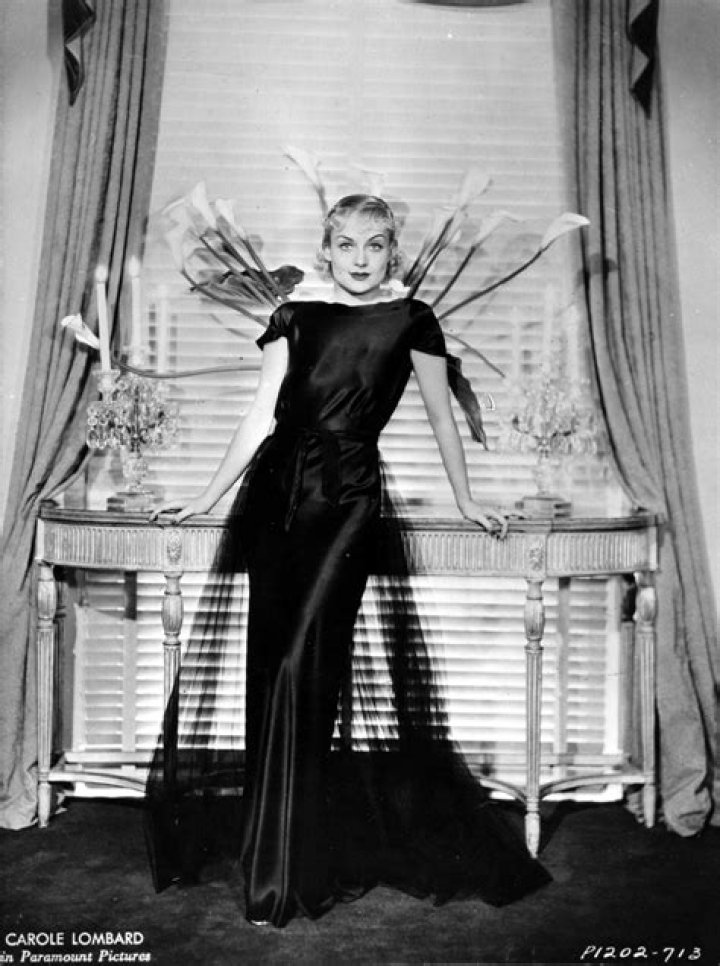
|---|
| 1 | Both of her husbands, William Powell and Clark Gable, starred in Manhattan Melodrama (1934). |
| 2 | According to Penny Stallings' "Flesh and Fantasy", Lombard drew a shadow along her natural cleavage line and lightened the top of her breasts to make them look larger. |
| 3 | She preferred the company of the grips, electricians and other off-camera workers to that of other actors. In her conversations with them, she could (and did) swear like a trooper. |
| 4 | She was flying on Transcontinental and Western Airlines (TWA) Flight 3 en route from McCarran Field, Las Vegas, Nevada, to Lockheed Air Terminal, Burbank, California, when it crashed approx. 33.1 miles (53 kilometers) southwest of Las Vegas at 19:20 (7:20 pm) on January 16, 1942. The aircraft flew into an almost vertical rock cliff, near the top of Potosi Mountain in the Spring Mountain Range. The three crew members and 19 passengers were all killed. The official accident report states that the crash was caused by "the failure of the captain after departure from Las Vegas to follow the proper course by making use of the navigational facilities available to him". |
| 5 | She was credited with the invention of the slang terms "she's so blonde" and "dumb blonde", due in part to the fact that she played several blonde scatterbrains during the 1930s and mid-1940s. |
| 6 | She once raised over $2 million in war bonds in one day. |
| 7 | In 1999, the American Film Institute ranked Carole Lombard #23 on their list of 50 Greatest American Female Screen Legends. |
| 8 | Lombard shared her first screen kiss with Buck Jones in Durand of the Bad Lands (1925). |
| 9 | She did a screen test for Charles Chaplin's comedy-drama film The Gold Rush (1925). |
| 10 | During the tour of Hearst's Castle in San Simeon, California, visitors are shown a second-floor bedroom where, the story goes, Lombard and Clark Gable spent their wedding night. It's a room with a beautiful view, and a huge water storage tank rests hidden above it. The water was gravity-fed from an adjoining hill to provide water to the estate. |
| 11 | One of her classmates at drama school was Sally Eilers. |
| 12 | Profiled in the book "Funny Ladies: 100 Years of Great Comediennes" by Stephen M. Silverman (1999). |
| 13 | Turned down the role of Ellie Andrews in It Happened One Night (1934). Claudette Colbert was then given the role and won a Best Actress Oscar for her performance. |
| 14 | She and Clark Gable first met in late 1924 while working as extras on the set of Ben-Hur: A Tale of the Christ (1925). They would make three films together as extras--Ben-Hur, The Johnstown Flood (1926) and The Plastic Age (1925)--and star together in No Man of Her Own (1932), but not become romantically attached until 1936. |
| 15 | She was good friends with Gloria Swanson. |
| 16 | After her death, the Van Nuys News ran an unusual front page tribute: "Down deep in their hearts, those who had chatted with her over the back fence or across a garden row knew that Carole Lombard wanted more than anything else to be a model housewife and a good neighbor. And she was just that. She was a loveable person, just as much at home in blue denims and ginghams as she was in furs and jewels.". |
| 17 | According to Garson Kanin, she never had a dressing room when shooting a movie. Instead, she preferred to socialize with the cast and crew members during her breaks. |
| 18 | Twice turned down opportunities to play a newspaperwoman, in Mr. Deeds Goes to Town (1936) and His Girl Friday (1940). The roles brought their respective actresses (Jean Arthur and Rosalind Russell) considerable attention. |
| 19 | She was often doubled by her old school friend, Dixie Pantages. Dixie had an even more unusual background than Carole herself did: she was born in extreme poverty, but when her mother died, she was adopted by the wealthy Pantages family so that their own daughter, a childhood playmate of Dixie's, could have a sister. When that happened, her name changed legally from Dixie Nelson to Dixie Pantages as a result of the adoption becoming legal. |
| 20 | Attended and graduated from Fairfax High School in Los Angeles, California in 1927. Was elected "May Queen" in 1924. Quit soon thereafter to pursue acting full time. |
| 21 | Just before her relationship with Clark Gable began in earnest, Carole read and loved the book "Gone With the Wind". Excited, she sent a copy of the book to Gable, with a note attached reading "Let's do it!". Gable wrongly assumed she was making a sexual advance to him, and called Carole to organize a date. When he found out Carole wanted to make a film of the book with him as Rhett Butler and herself as Scarlett, he refused, and kept the copy of the book she had given him thereafter in his toilet. |
| 22 | She had a little dachshund named Commissioner that ignored Clark Gable completely. After her death in 1942, the dog would not leave his side. |
| 23 | She was of English and German heritage. |
| 24 | Carol Lynley (born as Carole Jones a month after the actress' death) was named after Lombard. |
| 25 | Part of her honeymoon with Clark Gable was at the Willows Inn in Palm Springs, California. The Inn continues to operate and anyone can stay in the same room, called "The Library Suite". The room remains largely unaltered since the Gables stayed there more than 60 years ago. |
| 26 | Attended Virgil Junior High School on Virgil Avenue in Los Angeles, California in the early 1920s. The school currently exists as Virgil Middle School on Vermont Avenue, one block from the original school. |
| 27 | Her performance as Maria Tura in To Be or Not to Be (1942) is ranked #38 on Premiere magazine's 100 Greatest Performances of All Time (2006). |
| 28 | Was a second-generation Bahá'í who formally declared her membership to the Bahá'í Faith in 1938. |
| 29 | The plane crash that killed her took place less than a month before the Oscars. Despite her mother's premonition of the disaster, she refused to take a train to Los Angeles. She was reputedly in a rush after getting wind of an alleged affair between her husband Clark Gable and Lana Turner who were filming Somewhere I'll Find You (1942) at the time. The decision to take the plane was decided literally by the flip of a coin, with Carole winning the toss. |
| 30 | Considered by many to be the prototype for the icy blondes in Alfred Hitchcock's films. |
| 31 | She was offered the lead role in a proposed melodrama, "Smiler with a Knife", to be directed by a newcomer at RKO Radio Pictures named Orson Welles. She turned down the role, opting to return to screwball comedy in Mr. & Mrs. Smith (1941). Welles refused to make Smiler without her; instead, he began work on Citizen Kane (1941). |
| 32 | Lucille Ball said she finally decided to go ahead with I Love Lucy (1951) when Carole, who had been a close friend, came to her in a dream and recommended she take a chance on the risky idea of entering television. |
| 33 | The Jack Benny radio show that followed her death was cancelled because Benny, a good friend and admirer, was grief-stricken. The time was filled with music instead. |
| 34 | She was posthumously awarded a Star on the Hollywood Walk of Fame at 6930 Hollywood Boulevard in Hollywood, California on February 8, 1960. |
| 35 | Her film To Be or Not to Be (1942) was in post-production when she died in a plane crash, and the producers decided to leave out a part that had her character ironically saying, "What can happen in a plane?". |
| 36 | She was posthumously awarded the Medal of Freedom by President Franklin D. Roosevelt as the first woman killed in the line of duty in World War II. FDR greatly admired her work for the war effort, and ironically she was returning from an engagement selling War Bonds when her plane crashed. In 1983, Orson Welles claimed he had been told that Lombard's plane had actually been shot down by American Nazi sympathizers. |
| 37 | A natural tomboy with athletic prowess and spirit far exceeding her size (she was a petite child who stood 5' 2", with shoes), the future screen star frequently joined her brothers in roughhousing. |
| 38 | Cousin-in-law of Mary Astor, Athole Shearer, Bessie Love, Dee Hartford and Eden Hartford. |
| 39 | Both of her marriages were childless. |
| 40 | Second cousin of director Howard Hawks, Kenneth Hawks and William B. Hawks. |
| 41 | Following her untimely death, she was interred at Forest Lawn Memorial Park in Glendale, California, in the Great Mausoleum, Sanctuary of Trust. |
| 42 | Lombard was listed in the credits of Safety in Numbers (1930), her first Paramount release, as Carole (instead of Carol as in her previous billings). They decided that this would now be the official spelling and she went along with it. She legally changed her name to Carole Lombard in 1936. Only in her first film, A Perfect Crime (1921) did she use her real name, Jane Peters. |
| 43 | Linked romantically to crooner Russ Columbo until his accidental death late in 1934. |
| 44 | A 1926 automobile accident badly cut her face. Advanced plastic surgery and adroit use of make-up covered the scars. However, at the time the belief was that use of anesthetic during the operation would leave worse scars, so she endured the reconstructive surgery without an anesthetic. |
| 45 | During World War II, after her death, a Liberty ship was named after her. |